Project Gallery
Real water damage, fire, mold, and storm restoration jobs from across DFW. Documented start to finish.
Real jobs. Real customers. Real DFW. Every photo below is from an actual job completed by Flood Titan Restoration. We document every phase of every job for our customers and their insurance companies. Click a category filter to narrow down.
Why We Document Every Job, Frame by Frame
Restoration is one of the few service industries where the work disappears into the walls. Drywall goes back up, baseboard goes back on, the floor gets reinstalled, and ninety days later the only proof anything happened is the homeowner's memory of the loss. That is a problem when the insurance adjuster's desk team is trying to fund the scope, when a future buyer's home inspector finds residual evidence, or when the homeowner just wants to remember what was done and why. So we shoot every phase of every job.
The images below are not stock. Not stage-set. Not borrowed from a vendor's promotional kit. They are real DFW jobs — water losses in Southlake and Colleyville and Keller, mold remediation in Hidden Lakes and Marshall Ridge, storm response after the latest hail or freeze event, equipment deployed in real attics and real garages and real living rooms. The IICRC firm registration in the credentials category is the actual paper, not an industry-association logo. The Tyvek PPE shots are our owner-operator on a Category 3 demolition, not a stock model.
What you can read from this gallery:
- What the work actually looks like. Most homeowners have never seen a structural drying chamber, a thermal imaging moisture map, or a controlled Cat 3 demolition with containment poly. Knowing what to expect before you call helps you ask better questions.
- What documentation we deliver. Every customer gets a photo log timestamped at extraction-in, equipment-set, dry-out, and final restoration. The same documentation goes to your insurance adjuster. This is what that looks like.
- What gear shows up. Industrial dehumidifiers, air movers, HEPA backpack extractors, thermal imaging cameras, moisture meters, containment film, Tyvek PPE. If the vendor showing up to your home is missing the right tool, the drying scope is going to be wrong.
- What "IICRC certified firm" actually means. Look at the technique in the demo shots and the equipment deployment in the drying shots. That is what the S500 standard looks like in practice. Anyone can put the IICRC logo on a website.
If you are an adjuster or claims professional reviewing a Flood Titan file, the gallery is also a quick way to see the documentation discipline we bring to every job. The same level of phase-by-phase photo work shows up in the file you receive.




What Each Category Shows You
Water Damage (11 photos)
The largest category and the most informative for homeowners trying to understand what a real water-damage job involves. The shots include initial inspection cuts to investigate hidden leaks, controlled demolition of saturated drywall and insulation, HEPA-backpack extraction during Cat 3 demolition, contained Cat 3 garage work in full Tyvek PPE with P100 respirators, and antimicrobial application. The progression from inspection to demo to drying setup to antimicrobial treatment is the IICRC S500 process in practice. If the vendor at your door is skipping containment, skipping PPE, or skipping moisture verification, the file you receive will be missing pieces your adjuster needs.
Structural Drying (6 photos)
Drying chamber setups in real DFW homes. Industrial-grade dehumidifiers and low-profile air movers positioned to actually move air through the affected materials, not just sit in the room. The choice between LGR refrigerant dehumidifiers and desiccant dehumidifiers is driven by ambient temperature, grains-per-pound load, and the substrate's documented goal moisture content under IICRC S500. The photos document equipment selection and placement, which is the difference between a job that hits dry standard in three days and a job that drags out to seven and ends up with mold.
Mold Detection (4 photos)
Thermal imaging in real walls, moisture meter readings on framing, and visible-growth documentation. Mold remediation under IICRC S520 starts with detection — if you cannot see where it is, you cannot contain it, and you cannot remove it. The thermal imaging shots show what hidden moisture looks like when the human eye sees nothing. This is the technology your adjuster expects to see used on any mold-adjacent claim.
Storm Response (2 photos) & Equipment (2 photos)
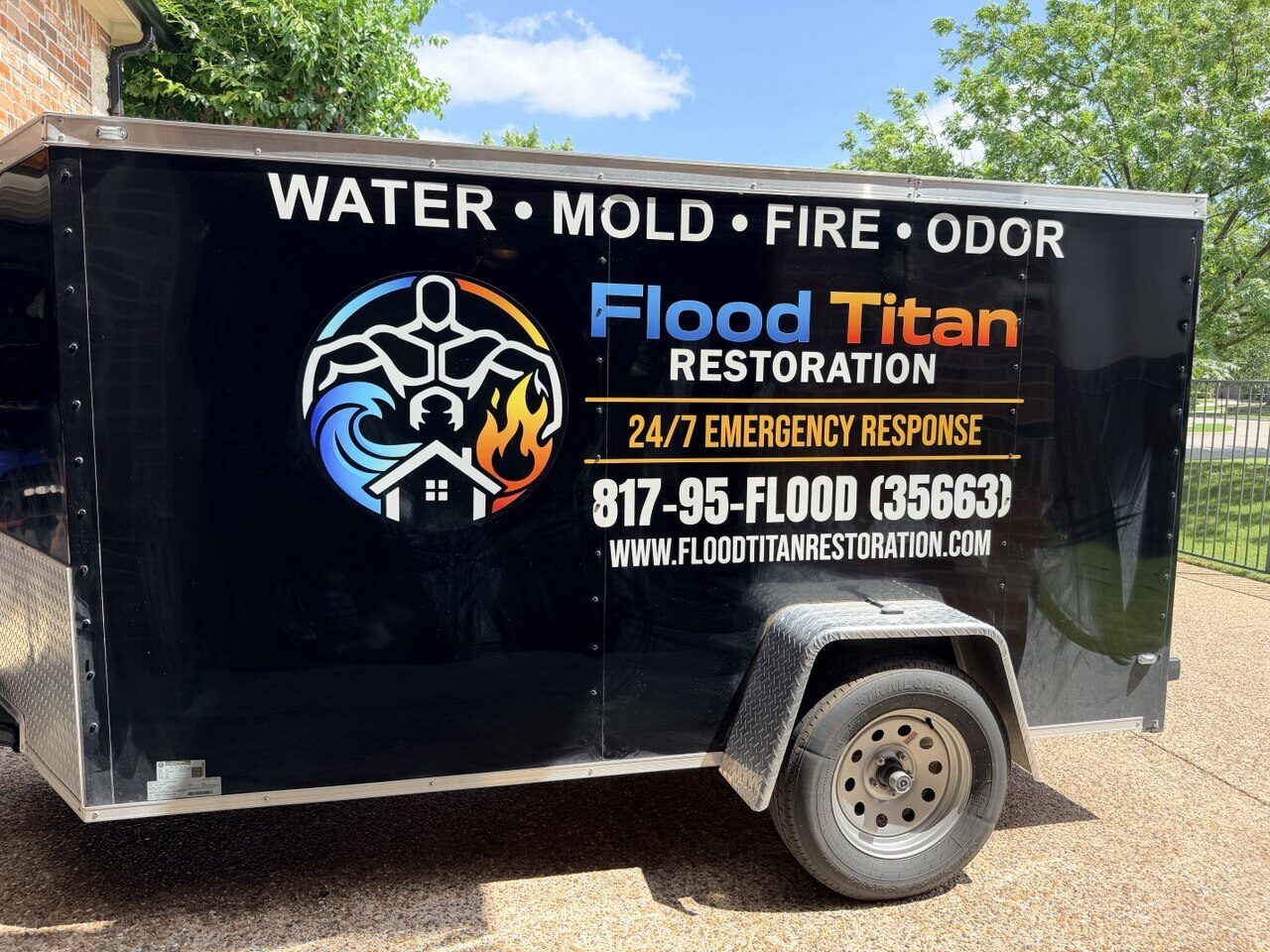
Truck-deployed, on-site after-hours response. The equipment photos document the gear that actually rides with us — extraction wand, generator-powered air movers, containment film, antimicrobial chemistry. Storm response shots are from actual North Texas hail and freeze events.
Pack-Out (1 photo)
Box truck loaded with shrink-wrapped customer contents during a residential pack-out. The shrink-wrap, the rear-ramp deployment, the curbside loading — these are the procedural details that distinguish a documented IICRC-aligned pack-out from a general moving service.
Before & After (1 photo) & Credentials (1 photo)
The before-and-after kitchen documents the full restoration arc: initial hardwood flooding, dehumidification and drying chamber running, fully restored kitchen at completion. The credentials shot is our actual IICRC firm registration (#70249559), not a logo download from the IICRC site.
How To Read a Restoration Vendor's Gallery
Most restoration company "galleries" online are stock photography. Pretty kitchens, smiling families, generic equipment beauty shots from a vendor's product catalog. They tell you nothing about the actual crew that will show up at your door. When you are evaluating a restoration company, these are the questions a real gallery should answer:
- Is this real work or staged? Real demolition is ugly. Real Cat 3 zones have visible contamination. Real drying setups have wires and hoses and equipment crowding the room. If every photo looks magazine-pretty, it is not real work.
- Does the PPE match the contamination class? Cat 3 demolition requires Tyvek, P100, gloves, eye protection. If a "Cat 3 cleanup" photo shows a tech in jeans and a t-shirt, the company either does not understand the standard or does not follow it.
- Is containment visible? Plastic sheeting walls, negative-pressure air filtration, zippered entries. These are not optional on Cat 3 water or mold remediation work.
- Is the equipment the right scale? A single small air mover and one consumer-grade dehumidifier is not going to dry a flooded kitchen. The equipment volume in the photos should look like overkill, because under-drying is the leading cause of mold callbacks.
- Is the credentialing visible and verifiable? The IICRC firm certificate is a public registry item. So is the firm's IICRC firm number. Anyone can put a logo on a website. The certificate photo and number are harder to fake.
A Note for DFW Insurance Adjusters
If you are an adjuster, claims manager, or desk reviewer evaluating a Flood Titan submission, the gallery is a quick window into our documentation discipline. Every job file you receive from us carries the same level of phase-by-phase photo work shown here, timestamped and structured for the way North Texas carriers underwrite. We document cause-of-loss at the source. We capture pre-extraction and post-extraction state of every affected room. We hold a daily atmospheric log throughout the drying phase. We verify dry standard against documented goal moisture content before any reconstruction begins. The file is built to fund the right scope on the first pass without supplements unless the scope changes mid-job.
Want to See More?
This is a sample of our completed work. Our Google Business Profile has additional photos updated regularly, and we're happy to share before/after photos of comparable jobs to your situation before you commit to working with us.
Got Damage? We're On The Way. 24/7. Call 817-95-FLOOD.
Call Now