Slab Leak Water Damage Restoration
DFW Hardwood, Subfloor & Concrete Drying
Slab leaks are the worst kind of water damage because the source is hidden under your foundation. By the time hardwood is cupping or a hot spot shows on the floor, the slab and subfloor have been wet for days. Flood Titan Restoration is IICRC Certified Firm #70249559. We locate the affected area with FLIR thermal imaging, lift hardwood to dry the subfloor and slab beneath, work alongside your plumber, and bill the carrier in Xactimate format. Owner-operated, locally based in Southlake.
How to Tell It Is a Slab Leak (Before You Demo Anything)
Most homeowners do not know they have a slab leak until it has been going for weeks. The water has nowhere to go but up, through the slab, into the subfloor and the bottom plate of every wall it can reach. Catching it early saves the floor.
Signs Worth Calling About
- Warm spot on the floor. A hot-water side slab leak transfers heat through the concrete. Bare feet pick it up before any visible damage shows.
- Water bill jumped, no obvious reason. A continuous quarter-inch stream is hundreds of gallons a day, all of it going under your house.
- Sound of running water with everything off. Stand in a quiet hallway. If you hear flow with all fixtures closed, it is leaking somewhere you cannot see.
- Hardwood is cupping in the middle of a room. Cupping comes from moisture wicking up from below. There is no surface source.
- Baseboards are rising or paint is bubbling near the floor. The slab is wicking moisture into the bottom of the drywall.
- Foundation cracks have moisture staining around them. Long-running slab leaks accelerate foundation movement on DFW expansive clay.
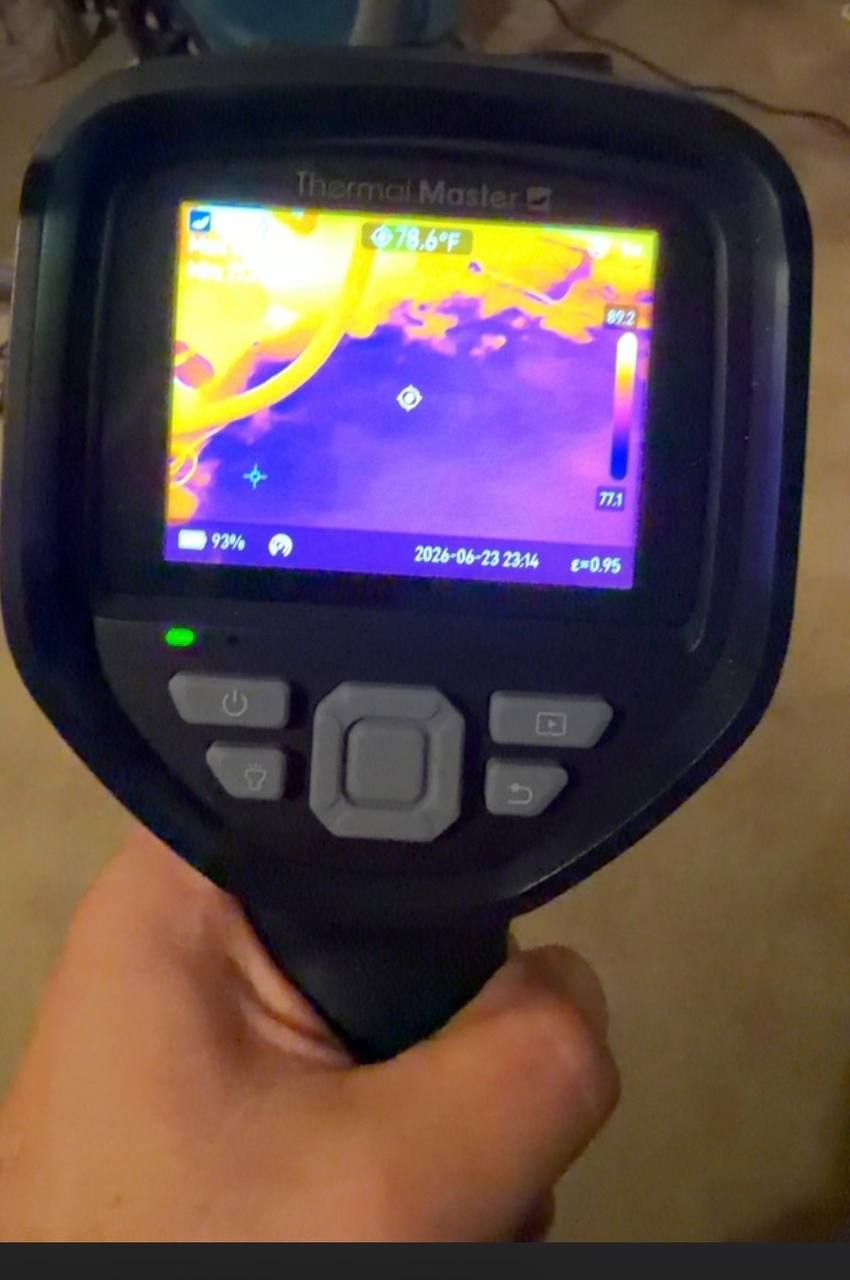
Actual thermal reading from a DFW slab leak call. The cool bloom is moisture wicking up through the floor before any board was lifted.
Why Slab Leaks Wreck Floors Faster Than People Think
Capillary action moves water upward through any porous material the slab touches. That includes the bottom of hardwood planks, the underside of tile thinset, drywall bottom plates, and any wood subfloor on a pier-and-beam transition zone. Per IICRC S500, the longer that wicking goes on, the more of those materials cross from dryable into remove and replace.
The 72-Hour Floor Window
- Days 1 to 3: Solid hardwood may cup but is usually still dryable with floor mat systems and vapor barriers.
- Days 4 to 7: Cupping becomes crowning. Subfloor swells. Engineered planks delaminate. Tile thinset releases.
- Day 7+: Material replacement, not drying. Mold colonization begins under the boards per IICRC S520 §3.4.
This is why slab-leak calls become tear-out and replace instead of dry and save. The homeowner waited for visible damage. By then the materials were past the dryable threshold. We tell you on day one which side of that threshold your floor is on, with moisture readings on the page in front of you.
What We Do When We Arrive on a Slab Leak Call
Our scope is mitigation and restoration. The plumber's scope is the leak itself. We coordinate the two so you do not pay twice for the same teardown.
-
Step 1: Locate & Confirm
FLIR thermal scan over hardwood, tile, and adjacent walls. Tramex moisture meter readings logged on a floor plan. We confirm slab leak versus other source before any demolition. You see the readings, not just our word.
-
Step 2: Stop The Loss
If your plumber has not already isolated the leak, we shut the main and brief them on what we found. We can usually have the plumber on-site within 2 hours through our coordination network. The plumbing repair (spot fix or reroute through the attic) is a separate licensed trade.
-
Step 3: Selective Floor Lift
We lift hardwood only over the wet footprint, not the whole floor, and only if the boards are unsalvageable. Salvageable boards get vapor barrier mats that draw moisture up and out through the surface without demolition. Tile gets dried in place or selectively cut for slab access.
-
Step 4: Clean and Disinfect Before We Dry
After the damaged flooring comes out, the exposed slab gets pressure washed, disinfected, and treated with an antimicrobial. Only then do the fans come on. The order matters: slab water that sat for days carries bacteria, and drying a dirty surface just blows that contamination through your home. We get it clean first, then we dry.
-
Step 5: Subfloor & Slab Drying
With the surface clean, LGR dehumidifiers and air movers are set to S500 psychrometric load. Concrete itself holds moisture. We monitor with calibrated concrete moisture meters and only pull equipment when readings hit IICRC drying goals. Typical timeline: 4 to 7 days.
-
Step 6: Document the Claim
Photo log, FLIR images, daily moisture logs, Xactimate scope written in carrier-aligned language, certificate of completion. We work directly with State Farm, Allstate, USAA, Farmers, Liberty Mutual, Travelers, Nationwide, and the rest of the major Texas carriers. The cleaner the file, the faster the approval.
-
Step 7: Rebuild
Refinish or reinstall hardwood, replace base trim, repaint, reset transitions. Same crew, same project number, same point of contact. No handoff to a separate reconstruction company.
The DFW Slab Leak Reality
North Texas sits on Houston Black and Eagle Ford clay soils that swell when wet and shrink when dry. Houses built in the 1990s and earlier across Southlake, Colleyville, Keller, Westlake, and most of the Mid-Cities used copper supply lines run under the slab. As the clay moves seasonally, those copper lines flex against the concrete. Eventually a pinhole opens. The water table doesn't drop, and the leak runs until somebody catches it.
Newer builds use PEX, which moves with the slab without fatiguing. If your house is from 2005 or later there is a good chance your slab plumbing is PEX. Pre-2000 builds in the older parts of Colleyville, west Southlake, and Keller historic district are the highest-risk inventory for copper pinhole slab leaks.
This is regional pattern, not anecdote. It is also why prolonged slab moisture is doubly dangerous in DFW: the very water that came from a failed copper line under the slab can accelerate the foundation movement that caused the leak.
Related Water Damage Causes We Handle
Slab leak is one of six common DFW water-loss scenarios we deep-dive. Each calls for different IICRC S500 scope. Find your situation:
Burst Pipe Drying
Freeze burst, supply line failure, attic line, in-wall break.
Water Heater Flood
Tank failure, pan overflow, expansion tank rupture in garage or attic.
AC Drain Pan Overflow
Attic air handler overflow staining ceilings during DFW summer.
Attic & Roof Leak
Saturated insulation, ceiling stains, hidden moisture in batts.
Cat 3 Sewage Backup
Black water, full PPE, antimicrobial scope, structural tear-out.
All Water Damage Services
Full water damage restoration hub for DFW homeowners.
Slab Leak Questions DFW Homeowners Ask Us
Slab Leak Right Now?
Every hour the slab stays wet, more flooring crosses from dryable into replace. Call our owner-operated line. Allan or a credentialed Flood Titan technician answers.
Trusted Credentials
IICRC
Certified Firm #70249559
BNI Member
Southlake Business Builders Chapter
5.0★
Google Reviews
24/7
Emergency Response